[Tom:] You don’t have to use dead keys. I mentioned it just to illustrate that even if you run out of space, you can still map characters to dead keys, which can multiply the number of available characters by a factor of 10 or more.
Got it!
Oh, I now see a possible source for a misunderstanding here: With “dead keys” I don’t mean ‘unused keys’. I’m referring to the fix term.
So I may be confusing the functions of Ukelele; and in fact they're separate from Hotkey allocation in KM?
The only (really only) function of Ukelele is creating/editing keyboard layouts.
So, yes, the two things you mention are not related at all.
Not even the actual mapping of your keyboard layout is relevant to KM’s hotkeys:
Example:
Key Code 33 is mapped like this on two different standard macOS layouts:
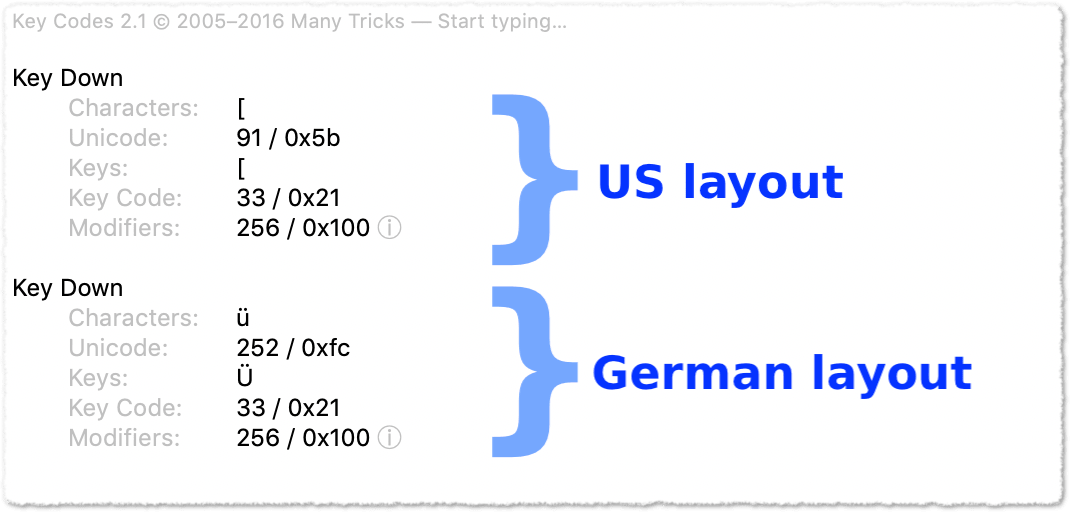
That is: Key code 33 gives you “[” with the US layout and “ü” with the German layout.
Now I set this hotkey as macro trigger:

It works.
Now I switch my keyboard layout to German…
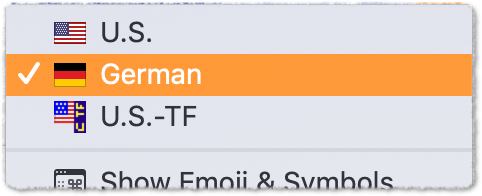
…and press the same physical hotkey, which is mapped to “Ü” in the German layout: It still works. (I do not have to press ⌥5, which is where “[” is mapped to on the German layout.) [1]
And when I reselect the macro in KM, I see that the trigger field has automagically changed to reflect the actual mapping of my current keyboard layout:

[Tom:] Let’s say, you often need the ♭ symbol. Then it likely is more comfortable to have it mapped to ⌥B than to have to trigger it by typing
;flatwith your text expansion software.
I see. That is indeed my case. Obviously I need to go back and look at Ukelele again
As said, with my article I tried to explain the basics of keyboard layouts and give a showcase of a custom layout, including advanced things like dead keys and multilevel (chained) dead keys. If my English there is too crappy, then download Ukelele and start reading the tutorial 
my Input Source > US Keyboard (default) currently has 30 favourites.
You mean, you have 30 layouts in this menu!?:
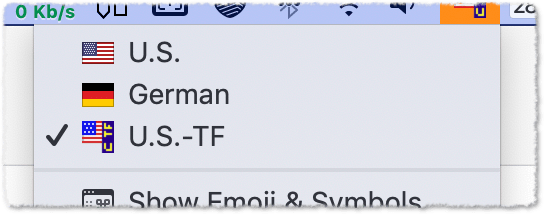
Why?
I think it is worth to mention that this is different from the standard/system behavior: In other apps, if I switch from US to German layout I can no longer use ⌘Z for undoing. I have to press physically ⌘Y. (Which is where the “Z” is mapped to on the German layout.) KM is smarter
 ↩︎
↩︎

