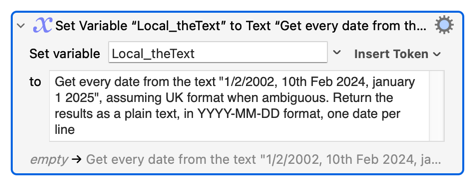
Keyboard Maestro would be the perfect agent to pair with AI. KM can already do the things on the Mac that AI alone cannot. KM would serve as the "hands" that carry out instructions, and AI would be the "brains" that fill in the gaps in the instructions.
I'm increasingly confounded by the LACK of Agentic AI tools for my Mac. (Not just within a browser on my Mac — I know those are starting to come online.) I'm using AI more and more in my day-to-day workflows and tasks.
But I can't ask an AI to take action on my files or folders for me (the way I can with Keyboard Maestro). Nor can I get an AI to expedite tasks within my various Mac apps (the way I can with Keyboard Maestro).
I hope there's some movement afoot to try this out!
EXAMPLE Use Case 1: I need to rename the files in my Downloads folder from something generic ("img_551071-4422.jpg") to something descriptive ("Serene landscape painting of calm lake reflecting mountains with cows grazing || WAS img_551071-4422.jpeg") — so I don't have to open each one just to discover whether or not it's the one I need. More examples:
"Download_2025-03-12.pdf" becomes:
"Water Bill for 123 Main St Concord NH 01234 $30.95 for Mar 2025 Due Apr 12 2025 Acct No. 123456789 || WAS Download_2025-03-12.pdf"
"a2Md345.pdf" becomes:
"User Manual for Printer Model T-200 || WAS a2Md345.pdf"
I could do this manually, of course, or manually with AI, one file at a time... But I want to batch this process for hundreds of files using KM (For Each...).
EXAMPLE Use Case 2: I'm looking for ways to save money on software subscriptions. I want to (a) find all invoices on my Mac that I've received from software companies in the past 24 months, and (b) make a PDF of each such invoice, and (c) place the PDFs in a new folder, and (d) create a simple spreadsheet listing all of the invoices (date, company, amount, etc.).
Rather than manually performing an exhaustive search for files created in the last 24 months and containing the text "invoice" or "bill" or "receipt", and then manually reviewing each one (or manually uploading each to an AI to perform the review), and so on…
With KM+AI, I could create a reusable macro that performs a search using Spotlight, where the AI sets the search parameters according to my prompt (Prompt for User Input). Then the macro uses the AI to review the resulting files, and determine which of them match the rest of the criteria in my prompt that can't be determined with Spotlight (it's an invoice or equivalent, from a software company, for a subscription, etc.). Then the macro prints a PDF copy of each matching file, saving the PDFs into a new folder (with an appropriate name created by the AI). Then the AI extracts the pertinent info (date, company, amount, etc.) from the PDFs and creates a CSV file.
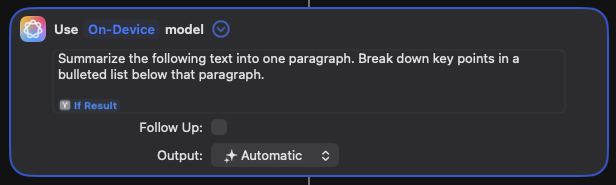
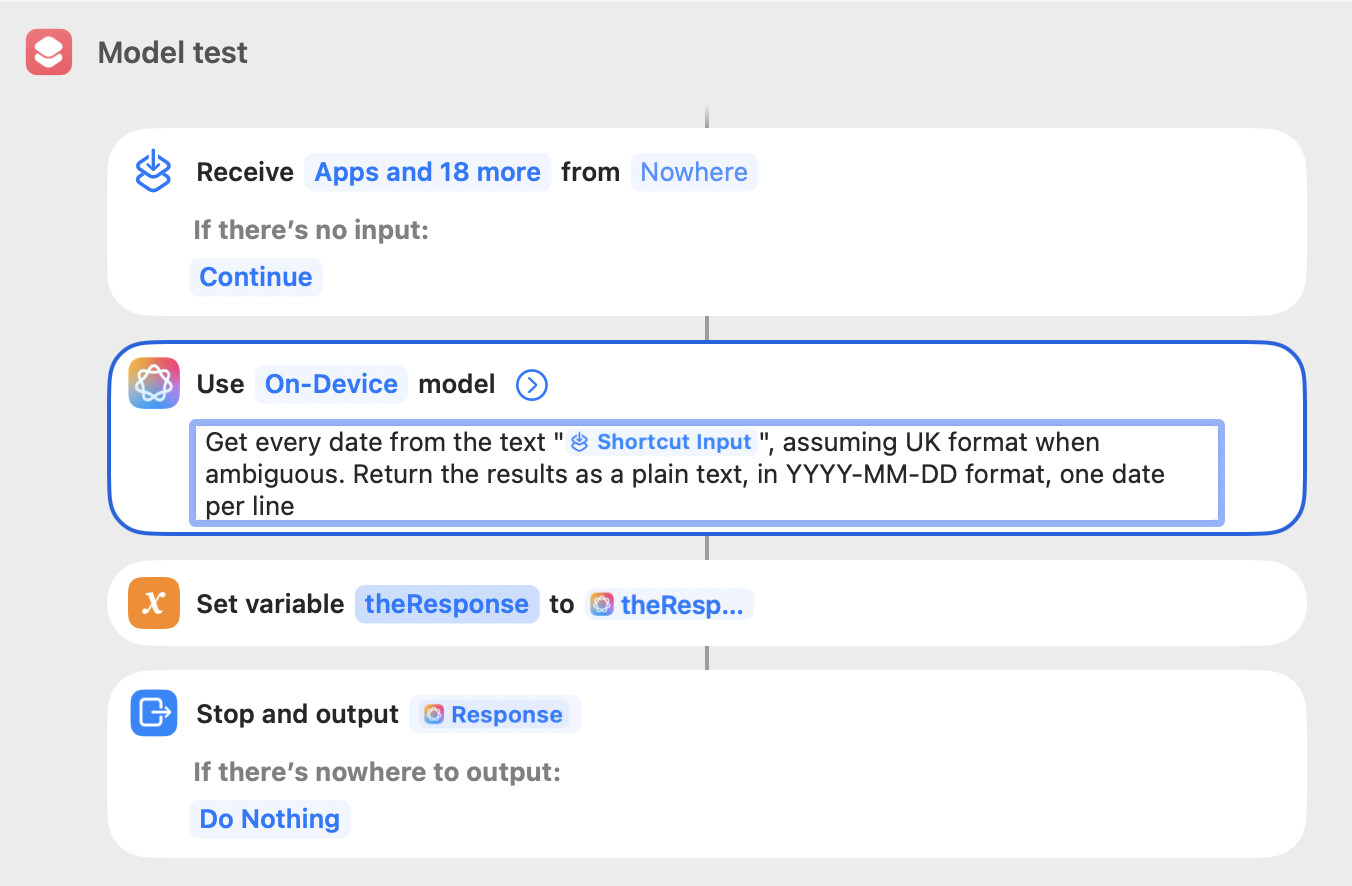
Yes, what you are asking for will be easy to do with the macOS26 Shortcuts app, with or without KM as a controlling app. No change will be required to KM to make this work, in fact I don't think you will need KM at all, as macOS Shortcuts should be able to do this without KM.
Why can you not do this now? Upload each image along with a "describe this image in 10 words or fewer" prompt, use the output to do the rename.
Similarly for your other examples.
If you can do it "manually with AI" you're 90% of the way there -- it's getting useable info out of the AI that's the problem, not the integration with KM.
I hope you don’t mind me briefly mentioning this here, but I recently published a Keyboard Maestro Third-Party Action Plugin that might be a small useful building block for ideas like these.
It adds a native Keyboard Maestro action for interacting directly with local LLMs through Ollama. The macro waits synchronously until the model has finished, and the result is returned natively so it can be passed straight into the next actions, variables, clipboard steps, loops, conditions, and so on.
So while it is not “AI built into KM” in the core product itself, it may still help as a practical way to connect local AI models into existing Keyboard Maestro workflows today.
To be honest, I'm not sure there are many people running an LLM on their local machines—even outside this forum amongst my fairly-geeky friend base, only one person has even experimented with this, and he stopped after a few months.
That may be a large part of the reason why you haven't had much response to your plug-in post.
Personally, I read the initial post, and it sounds like quite the impressive piece of work. But I have no interest in setting up a local LLM, so I moved on to the next thing, as I had nothing to add to your topic in the way of useful feedback.
And especially regarding “TranslateGemma” — the LLM model that I also show in the example for my Plugin — this model (published in January 2026) is amazing for translation work.
There is already some interesting material available for those who want to explore it further (for example: https://www.communeify.com/en/blog/google-translategemma-gemma-3-opensource-translation-model/ )
Personally, I do a lot of translation from one language to another. In my experience, proprietary models are still slightly better in terms of quality. That said, I believe the future may well involve using multiple AIs, depending on the specific application. In my own case, I have found that this particular compromise, combined with Keyboard Maestro, works very well for certain workflows, such as translation. The speed advantage of using a macro directly within any application and pasting the translated text back immediately, instead of switching apps, opening a new chat, pasting the text, waiting, copying the result, and pasting it back again, is well worth the compromise for me.
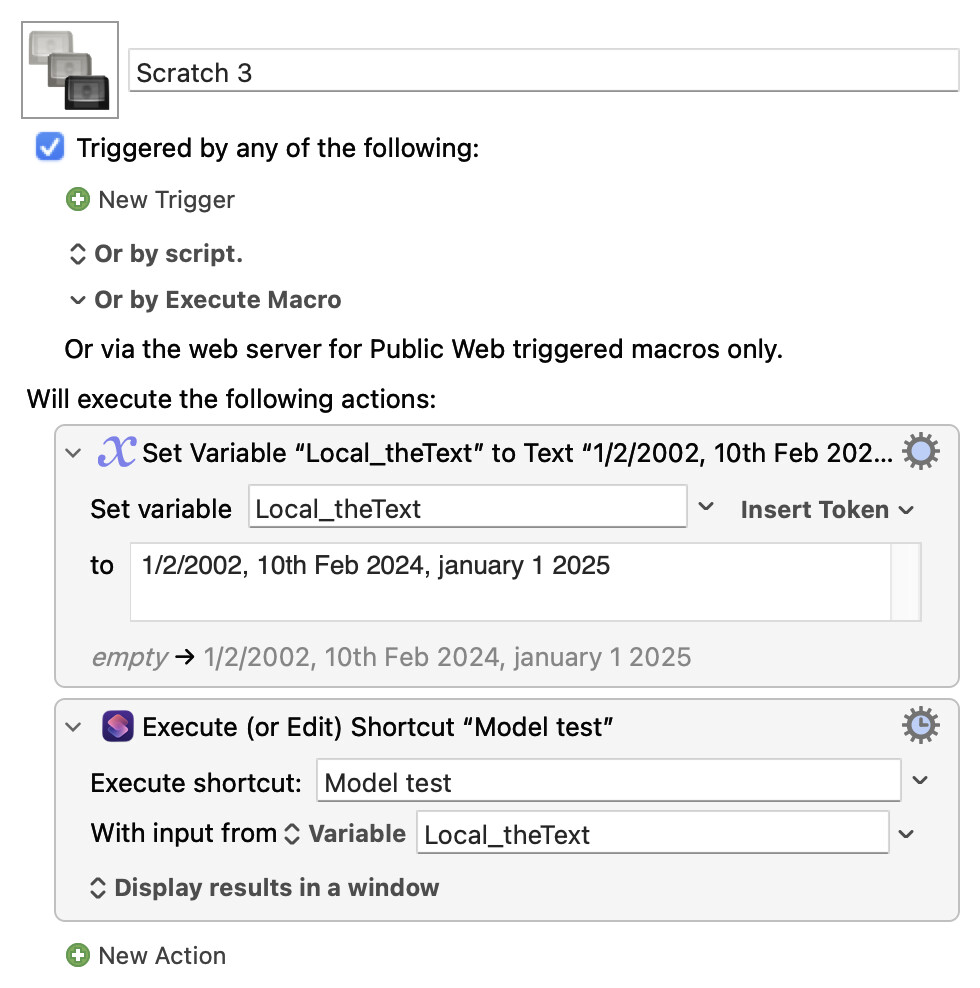
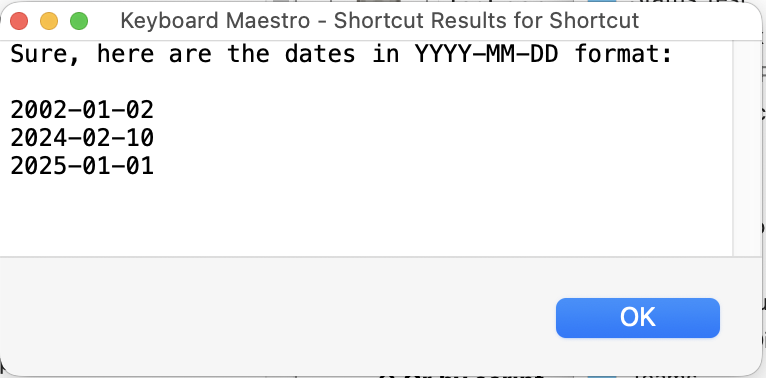
Thanks also for your question. I did look into it briefly. It seems that there is not yet an official API available from Apple that would allow this to be done directly. However, the workaround from @Nige_S works perfectly well because it passes everything through Apple Shortcuts instead.
I won't disagree that for certain needs, or even businesses in general, there are better alternatives than a commercial service. My point was that this is primarily an end-user forum, and amongst that crowd in my social group, there isn't anyone running their own LLM.
Why? Because the time involved to set up and manage a local LLM isn't worth it, or the technical experience bar is too high, or there isn't enough RAM or drive space, or whatever ... for us casual users, the hosted AIs will probably be sufficient for many years to come. For a grand total of $200 a year, I've got access to more power than I will ever personally need.
If something came along that worked just as well, installed and updated with a double-click, and didn't require massive amounts of CPU, RAM, and disk space, then maybe I'd be interested. But until such a thing happens (unlikely, given LLMs need all three of those things to work well), a commercial service offers me everything I need.
As noted, I understand this won't be true for all users; I was specifically thinking about the typical individual user on their Mac.
If you haven't already, take a look at LM Studio. It doesn't solve all problems, but it does make setup easy and a careful choice of quantized model will let them run on even modest hardware.
Why bother? Because:
That $200 price is hugely subsidised in the AI companies' quest for users -- some suggest we're paying only ~10% of the cost of inference, never mind the development and training costs (and the companies' and VCs' expected profit!).
If that $200 becomes $3,000+ then local LLMs will seem a lot more attractive!
Thank you for mentioning that model here. I installed it on my MacBook Air 15″ with 16 GB RAM. When I tried to replace the 4B model with the 12B model, I got errors. What model do you use? And what are the specs of your Mac?