Over in this topic…
...@Nige_S recommends using a handy old Apple app, UIElementInspector, to get values for various UI elements. It's a great tip, and the app is much easier to use than the full-blown modern replacement, Accessibility Inspector.
However, it has an issue: UIElementInspector's code is ancient, last updated in 2010. As such, it's Intel-only, which means its life expectancy is limited. for those upgrading to macOS 27 (Golden Gate), which drops support for Intel code—and Golden Gate might be released within a couple hours, but certainly within the next couple of weeks. Golden Gate drops support for Intel Macs, and Apple has made it clear that Rosetta 2, the tech that lets Intel apps run on Apple Silicon Macs, has a limited future, though they haven't said exactly how long it will be around.
To prepare for that time, whenever it is, I updated the UIElementInspector app to run in ARM 64 native code. But as I'm not a developer, I used AI in Xcode to get this done. You must (duh) have Xcode installed, and must have configured one of its supported agents (Claude, Codex, or Gemini).
Assuming you meet those requirements, open the Xcode project file (it ends in .xcode) for the UIElementInspector project, go to the AI input section of Xcode, and give it a prompt to update the app—here's the exact wording I used:
this is an old apple tool to provide accessibility API information. it is intel only. can you update it to run on apple silicon? (it doesn't need to support intel at all any more.)
Claude then worked for a few minutes, had me make a few changes in the project's settings, and ... it was done:
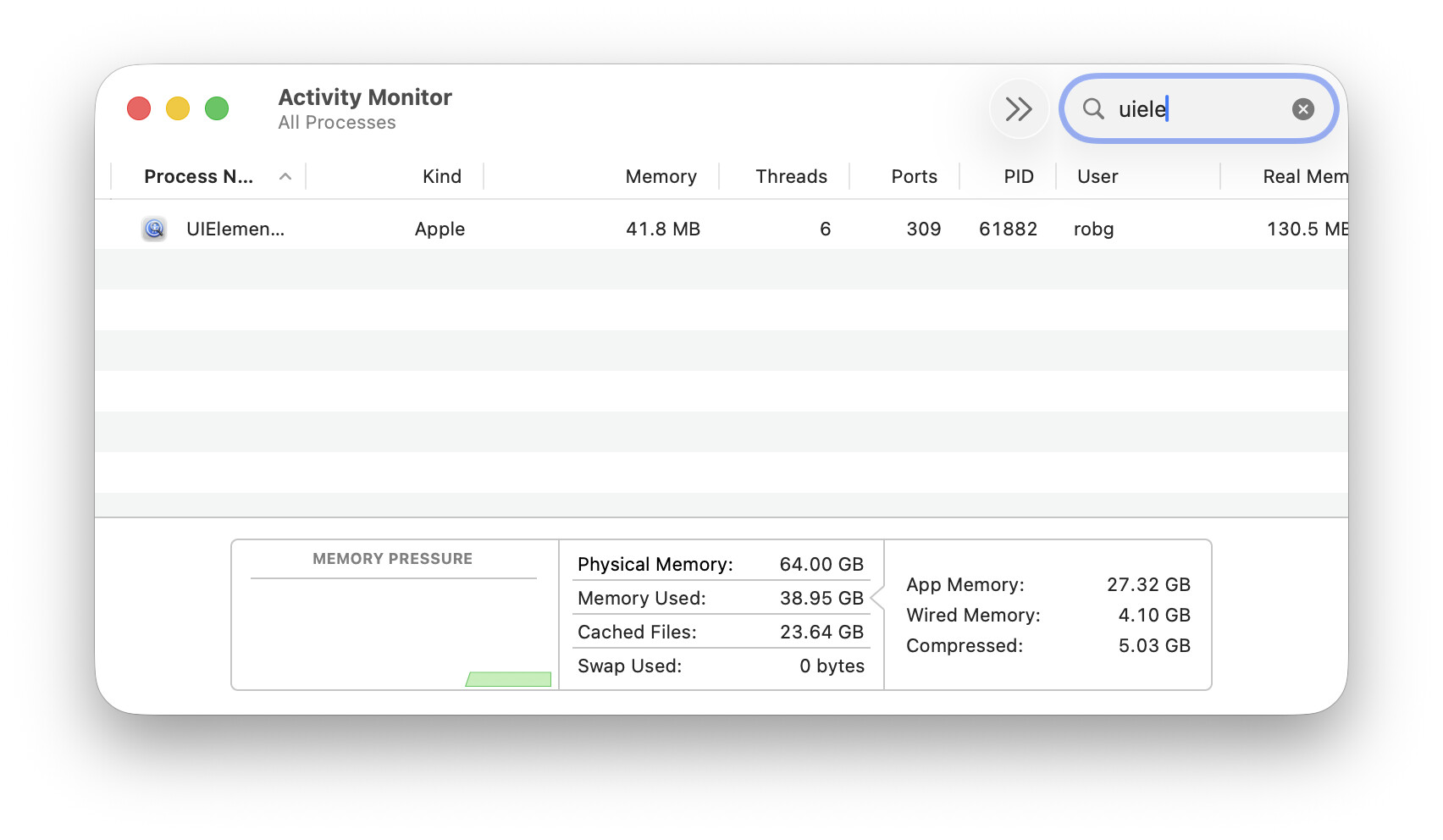
The Apple value in the Kind column shows that the app is running natively on Apple Silicon. So now I have a native UIElementInspector that I can keep using after I update to Golden Gate Rosetta 2 dies, whenever that may be.
I cannot distribute the modified code, as it's under Apple's copyright.
But it took just that one prompt and a couple minor edits (as directed by Claude) to turn the Intel-only ancient code into future-proof ARM-64 native code.
-rob.
